Hi all. I hope you’re keeping well. Today, I will be combining two topics that I don’t believe have ever been conflated before. So, this will either be really good or really bad. Let’s hope for the former. I’m going to be talking about British politics and The Lord of the Rings. So, if you’re into voting rights and goblin fights, this is the blog for you. If you like the ballot box and Balrog shocks, you’re in the right place. Whether you’re Rishi Sunak or “and my axe!”, you’re welcome here. I could sit here thinking of these all day! Let’s just get started. Enjoy:
My interest in politics is a bit of a strange one, in that I don’t really know where the interest stemmed from. In what I imagine is the case for most, I had basically no interest in politics as a child. I’d be vaguely aware of the big stuff: Blair and New Labour, 9/11, and the subsequent “War on Terror,” etc. But I certainly didn’t follow particularly closely.
I was excited to be able to vote when I turned 18, but without really knowing much about the different political parties. It wasn’t until my early to mid- twenties that I started looking at it a little more closely. For all of its many faults, I think social media probably played a role in this.
Acknowledging that correlation doesn’t necessarily equal causation, I signed up to Facebook when I was 21, and I joined Twitter when I was 23 or 24. So, it certainly aligns with the sort of time my interest in politics was piqued.
I guess interest is relative. I was recently filling in an online survey that asked, on a scale of 1-10, how much attention did I pay to UK politics. I answered a solid seven. I probably pay more attention than the average person in the UK. But I’m certainly not tuning into PMQs or Question Time every week.
One aspect of British politics that I didn’t really have a clue about when I was younger was the first past the post voting system. For those unaware of what this is, I’ll attempt to explain briefly.
In a general election in the UK, like the one we had recently, which saw Keir Starmer become Prime Minister, there are 650 constituencies across the UK. Each constituency holds a vote, with a maximum of one candidate per political party (I don’t believe there is a limit on how many independent candidates can run in each area).
The votes are counted up in each area, with the candidate/party with the most votes winning that area’s seat (as in, a seat in Parliament). The winner of the constituency vote becomes – or remains – the Member of Parliament (MP) for that area. Once a political party has won at least 326 seats (over half of the 650), they have essentially won the election and can form a government.
There are some problems with first past the post (FPTP). The biggest of which is probably that the majority of the country will often end up with a ruling party that they didn’t vote for. For example, in the most recent general election, Labour only received 33.7% of the votes across the country. It was a similar story for the Conservatives in 2015, when they received 36.8% of the votes.
An alternative to FPTP is some form of something called proportional representation. There are numerous ways this could potentially work, but the basic outcome would be that each party would get the same percentage of seats as votes. So, if proportional representation was in place for the recent general election, instead of winning 411 seats, Labour would have got 219 (33.7% of the 650).
Now, this math is purely theoretical because another problem FPTP throws up is the prospect of tactical voting. It’s easily possible that Labour may have received a smaller (or larger!) vote share if proportional representation was in place. Let me give you an example of how FPTP strong-armed me at the general election.
I’ve voted for Labour in every election my entire adult life. I don’t think you can ever fully support one party, as there will always be elements of their policies or proposals that you might not agree with. But, broadly speaking, Labour’s values/decisions have aligned with what I believed to be right.
That was until the run up to this election. I didn’t like Labour’s response to the situation in Gaza. They took too long to call for a ceasefire, in my opinion. I also didn’t like the way they spoke about the trans community (and Wes Streeting’s puberty blockers debacle since coming into power suggests that it was worse than I feared). Lastly, Labour’s lurch to the right regarding immigration left a sour taste in my mouth.
In an ideal world, I would have voted for a different party. Probably the Liberal Democrats, perhaps even the Green Party. Those are the two parties that most closely align with my values. But I voted for Labour. And FPTP is mostly to blame. You see, my main aim at this election – and there were a lot of people across the country in the same boat – was to vote out the Conservatives. So, it was less about who I wanted to vote in, but more about who I wanted to vote out.
In the constituency I live in, it is a very conservative area. The Tories have held this seat for a long time. The only party that has got near them in terms of the number of votes received (and, in truth, not that near over the last decade or so) is the Labour Party. And so it proved this time. Both the Conservative and Labour parties received 18,000+ votes. The Conservative candidate actually only won by 20 votes in the end, which was a bitter pill to swallow for me; I was so close to seeing the Conservative MP unseated in my area.
Slightly worryingly, as a person of colour, the next highest vote share in my area was for Reform, who received around 11,000 votes. The Lib Dems and Green Party both received about 2,000 votes each. So, you see, me voting for the Lib Dems or Greens would have basically been a wasted vote; they had no chance in my area. All my voting for them would have achieved is slightly increase the distance between Conservative and Labour.
Without wishing to sound patronising, I do wonder how many of the people who did vote for the Lib Dems or Greens in my area were aware of how FPTP works. It’s possible they all did and, similar to me, felt uncomfortable voting for Labour, for whatever reason. And, even though they knew it would likely lead to the Conservative candidate keeping his seat, they decided to avoid Labour anyway. But I can’t help wondering whether there were perhaps at least 20 people out of the 4,000+ who voted Lib Dem/Green who, again like me, wanted to see the Conservatives lose, but they didn’t realise voting Labour was the only credible way to make it happen.
Still, as far as tactical voting is concerned, some people had it way worse than me. For some left-leaning individuals, they had the Sophie’s choice of either the Conservatives or Reform winning in their area, so some were having to tactical vote Tory to try to curb the rise of Reform, who many would consider to be the worst of two evils.
FPTP has hobbled and humbled Labour in the past, particularly recently. It had been suggested that the Tories would never ditch it, as it was an almost guarantee that they would stay in power. They have subsequently been so shambolic that even FPTP couldn’t save them. The hope of many has been that if the Conservatives were ever removed from power, that would be the time to scrap FPTP and move to proportional representation. I don’t think this will ever happen, though. Certainly not under this Labour government.
At this juncture, you may be wondering when I was planning on talking about Lord of the Rings (LOTR). Right now! Thank you for your patience. You see, I think LOTR provides a perfect analogy for the predicament we find ourselves in with FPTP:
In this analogy, the Conservative Party is Sauron: all powerful and pure evil. The Labour Party is Isuldur: in a long, brutal battle with Sauron, desperately trying to defeat him. First Past the Post is the One Ring: the magical item that protects Sauron and keeps him in power.
Now, as those of you who know your LOTR know, Sauron seemed like he would rule forever and that no one would be able to defeat him. Until one battle where Isuldur cut the ring from Sauron’s hand. With the battle won and Isuldur now in charge, he had the chance to destroy the ring. Instead, he was corrupted by the ring, and he decided to keep it for himself. He reasoned that, with the ring for himself, he would be unbeatable. That didn’t turn out to be the case, and that is just the start of a very long story.
I’m sure you all followed the analogy without issue, but just to be clear on what I mean, I think the Labour Party will feel that, now that they’re the ones in power, moving to a proportional representation voting system will only harm their prospects of staying in power. So, as far as this goes, we’re doomed.
In terms of the analogy, I can expand it further. Reform is Saruman: just as evil as Sauron, but with a lot more ‘White Power’. Competing for power, perhaps foolishly, rather than combining forces.
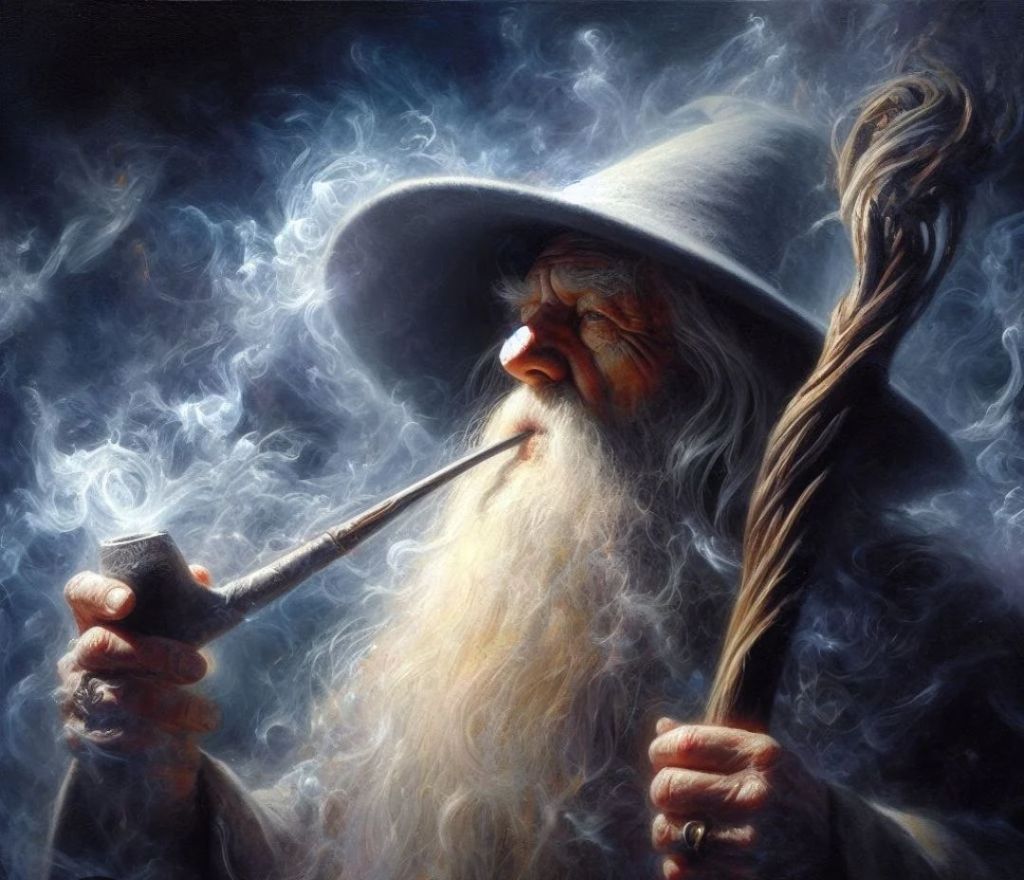
The Lib Dems and/or the Green Party are the Hobbits: smaller and weaker than the other characters, but maybe – just maybe – they will be the ones to cast the ring into the fires of Mount Doom. The odds are very much stacked against them, but we live in hope. Also, Gandalf absolutely loves them. He says it’s because he likes to support the little guy, but we know that he’s really just in it for their liberal views on weed.
Thank you for joining me again, my dear readers. I am obviously nowhere near Tolkien’s level as a writer, but I do possess one thing that he didn’t: brevity! So, on that note, I’ll leave it there. See you next time.
Just one very final note. Rest in peace, Alice Aguiar, Bebe King, and Elsie Dot Stancombe. For what little good it will do, I send my thoughts and love to their grieving families. I sometimes despair at the state of this world. But I do believe that it is better to live with hope than hate. And I do hope we are heading towards a more peaceful world 🕯
Rob Recommends
Mr Bigstuff – TV – 8/10
It seems as if Sky have made a real concerted effort to produce more comedies for adults over the last few years. And, not just standard comedy, but shows in which there are also plenty of touching or sad moments included too. Mr Bigstuff is no exception, but it does its own thing too.
There are only six episodes (so far, but there will surely be a second season before long), but I’ll save you some time: just watch the first episode. If you don’t like it after that, you probably won’t ever like it. I think it’s a brilliant show, though, written by – and starring – Ryan Sampson. More on him below.
Plebs – TV/Film – 7/10
Another Ryan Sampson show, though he didn’t write this one. He co-stars as lazy slave Grumio, living hand-to-mouth with his two friends in Ancient Rome. It’s a very funny show, which cleverly tells modern-style stories, but set around 27BC.
This probably would have gotten a higher score, but they unfortunately made a grave error in a casting decision that I just can’t get past. At the beginning of the fourth season, they killed off my favourite character. To be fair, this wasn’t really their fault; the actor who played him decided he’d had enough after the third season. Which is fine.
But, they then brought in a new character who is so unlikeable it’s almost unbelievable. And it wouldn’t have been a problem if the new character was supposed to be unlikeable. But he was clearly meant to be likeable. He’s played like he’s supposed to come across as this cheeky chappy, but he’s too much of a prick most of the time. He does get better as the show goes on, but I never warmed up to him. Don’t let that put you off, though, especially for the earlier seasons.
 A Rob Blog